The pursuit of knowledge relies entirely on trust. Every breakthrough and historical analysis builds upon previous discoveries. In this interconnected academic ecosystem, intellectual honesty is not merely a bureaucratic requirement; it is the fundamental currency of progress.
When that honesty is compromised, the entire structure falters. Among the various ethical infractions that can compromise a study, academic plagiarism remains one of the most pervasive and damaging. For contemporary researchers, navigating the boundaries between synthesis, collaboration, and unintended duplication requires deliberate effort and deep technical understanding.
Understanding the Landscape of Plagiarism in Research
To effectively mitigate the risks of intellectual misappropriation, one must first dismantle the misconception that it only occurs through deliberate, malicious copying. In professional scholarship, outright literary theft the verbatim duplication of another author’s work without attribution is relatively rare. Instead, contemporary researchers more frequently grapple with subtle, unintentional forms of duplication that can be just as damaging to a career or publication track record.
Types of Plagiarism in Research
The modern understanding of intellectual property encompasses several distinct categories of misattribution:
- Verbatim Plagiarism: The exact word-for-word copying of text from a source without using quotation marks or providing a citation. This is the most direct and easily detected form of intellectual theft.
- Paraphrase Plagiarism: Altering a few words or changing the sentence structure of a source text while retaining the exact core ideas, logic, and arguments without providing a citation. Intellectual property applies to the underlying ideas and conceptual architecture, not just the specific words used to express them.
- Self-Plagiarism (Text Recycling): Reusing parts of one’s own previously published papers, book chapters, or conference proceedings without explicit disclosure or citation. The Committee on Publication Ethics (COPE) offers clear guidelines noting that reusing substantial portions of text without disclosure compromises the transparency of scientific literature and distorts the scientific record.
- Patchwriting: Stitching together a mosaic of different source phrases, changing only a few connective words while leaving the primary structure intact. This frequently occurs when authors struggle to translate complex concepts into their own words.
- AI-Generated Duplication: Relying heavily on large language models (LLMs) to synthesize data or write literature reviews. Because these models are trained on existing copyrighted texts, they can inadvertently generate phrase patterns that mimic source materials too closely, triggering institutional red flags.
The consequences of failing to address these nuances extend far beyond a simple desk rejection from a journal editor. For early-career researchers and established faculty alike, a formal allegation can trigger institutional investigations, the loss of grant funding from agencies like the National Science Foundation (NSF) or National Institutes of Health (NIH), and the retraction of published papers. A retraction leaves a permanent mark on the digital record, damaging professional relationships and undermining public trust in science.
Practical Methodologies: How to Avoid Plagiarism
Developing a rigorous workflow that eliminates the risk of duplication requires moving beyond good intentions. It demands systematic habits that protect your writing from the very beginning of the literature review process. When researchers find themselves facing formatting issues or text duplications close to a submission deadline, it is often a sign of structural flaws in their note-taking and drafting stages.
[Literature Review] ──> [Rigorous Note-Taking] ──> [Synthesis & Drafting] ──> [Digital Verification]
(Gathering) (Source Tagging) (Blind Writing) (Software Scan)
How to Avoid Plagiarism: Practical Writing Methods for Researchers
To establish a bulletproof writing workflow, implement these standard research practices:
- Implement Immediate Source Tagging: When compiling a literature review, it is easy to copy and paste compelling quotes into a working document with the intention of citing them later. To prevent this from turning into accidental plagiarism, use a strict color-coding or tagging system in your reference management software (such as Zotero, Mendeley, or EndNote). Every copied phrase must be enclosed in quotation marks immediately and paired with its complete metadata, including the Digital Object Identifier (DOI) and specific page numbers.
- Practice Blind Paraphrasing: Instead of looking directly at a source paper while writing, read the passage, close the document, and wait a few minutes. Then, explain the concept in your draft as if you were describing it to a colleague. This technique forces your brain to process the information and express it using your own vocabulary. Once you have written your version, return to the original text to ensure you haven’t accidentally copied distinct phrasing, and immediately add the necessary citation.
- Verify Reference Exports Manually: While reference managers are incredibly helpful for organizing sources, they are not infallible. They frequently generate formatting errors, misplace initials, or drop italicization during automated exports. Authors retain full responsibility for the accuracy of their bibliography; relying on an automated tool does not excuse a faulty citation. Know your specific style guide (APA, AMA, IEEE, or Chicago) inside and out.
- Distinguish Common Knowledge from Novel Ideas: Facts that are widely accepted across an entire discipline (e.g., “DNA consists of four nucleotide bases”) do not require a citation. However, specific experimental data, unique methodologies, and specialized theories always do. When in doubt, always err on the side of caution and include the citation.
- Partner with Professional Academic Editors: For international researchers writing in a second or third language, the pressure to produce elegant English prose can sometimes lead to an over-reliance on the phrasing of native-speaking authors. This is where professional human editing becomes invaluable.
Digital Safeguards: Tools to Detect Plagiarism in Research Papers
In an era defined by massive digital databases, human review alone is no longer enough to guarantee text originality. Editorial boards and university libraries now routinely use advanced text-matching software to scan every submission before peer review begins. To protect your professional standing, incorporating a professional software scan into your personal pre-submission workflow is a vital final step.
When looking for a plagiarism checker, researchers have access to various specialized systems. The table below outlines the leading professional tools to detect plagiarism in research papers, comparing their target audience, unique core technologies, and database depths.
| Plagiarism Checker Tool | Best Suited For | Core Technology & Standout Feature | Scholarly Database Depth |
| iThenticate | Journal editors, publishers, and high-stakes manuscript screening. | High-level manuscript tracking system integration; focuses strictly on professional scholarly verification. | 244 million+ premium publication sources; 85,000+ top research journals. |
| Turnitin | Universities, colleges, and institutional academic workflows. | Proprietary global student paper repository; refined multi-model AI writing and paraphrase detection flags. | Massive repository of global student submissions + historical web archives. |
| Paperpal | Researchers, PhD scholars, and academic manuscript preparation. | Context-aware academic similarity detection combined with real-time editing and language improvements. | 99 billion+ web pages; 200 million+ Open Access research articles. |
| Quetext | Contextual analysis and identifying structural plagiarism. | DeepSearch™ technology for advanced fuzzy matching, synonym substitution, and ColorGrade™ reporting. | Extensive web index paired with targeted academic text repositories. |
| Copyleaks | Multilingual research and hybrid AI-human text detection. | Advanced multi-language algorithms; tracks cross-language plagiarism and mixed human-AI writing patterns. | Comprehensive web crawl + open-source repositories across 100+ languages. |
| Grammarly | Undergraduates and draft-stage casual academic checking. | Real-time plagiarism detection built directly into an all-in-one style and grammar editing interface. | 16 billion+ web pages combined with the ProQuest academic database. |
Evaluating Your Similarity Index: Context Over Numbers
When interpreting a report from any of these platforms, remember that a similarity score is not a definitive verdict on ethical behavior. For instance, a manuscript can show a 20% similarity score due to standard methodology descriptions, common laboratory terminology, and correctly cited direct quotes. Conversely, a paper with a mere 5% similarity score might still contain plagiarized material if a core hypothesis was lifted directly from another author without credit. Therefore, journal editors look at the specific context of each highlighted match, rather than focusing on the number alone.
Need Expert Assistance? Discover Our Academic Services
Explore the specialized solutions offered at Thesis-Edit Academic Services, where our native English-speaking PhD editors handle the technical complexities of your text:
- Comprehensive Thesis Editing & Proofreading: We thoroughly refine your grammar, syntax, academic tone, and logical flow across every chapter, making your arguments transparent and compelling.
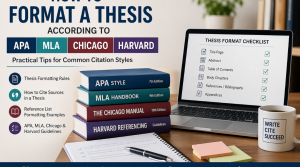
- Rigorous Citation & Reference Formatting: Our team meticulously verifies your in-text citations and bibliographies against your required style guide (APA, MLA, Chicago, Harvard, or institutional rules) using trusted reference managers to resolve formatting issues.
- Plagiarism Resolution & AI Content Reduction: Every comprehensive editing package includes an objective plagiarism checker scan and Turnitin report. So, If high similarity indices or unintended paraphrasing structural patterns are detected, our subject-matter specialists actively help you rephrase and isolate sources properly.
Conclusion
Upholding academic integrity is vital to protect your personal reputation and the broader scientific record. By using structured note-taking methods, learning how to avoid plagiarism, and verifying your text with an advanced plagiarism checker, you ensure your plagiarism in research risks fall to zero.