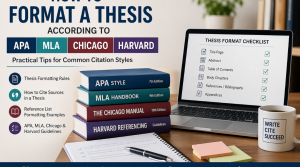
Understanding referencing styles is an essential part of academic writing. Whether you are preparing an essay, dissertation, thesis, or research paper, you must properly acknowledge the sources you use. Different citation styles such as APA referencing, MLA referencing, Chicago style citation, and Harvard referencing provide standardized rules for citing books, journal articles, websites, and other materials. These academic referencing styles help students avoid plagiarism, improve credibility, and present research professionally.
What Is a Citation Style?
A citation style is a system of rules that explains how to credit information taken from another source. It tells writers how to cite references inside the text and how to list sources at the end of the document.
For example, if you use information from a book written by John Smith in 2024, different citation styles will format the reference differently.
APA style:
(Smith, 2024)
MLA style:
(Smith 45)
Chicago style:
¹John Smith, Research Methods (New York: Oxford University Press, 2024), 45.
Each style follows its own formatting structure depending on the academic discipline.
What Is a Referencing Style?
A referencing style refers to the complete system used for documenting sources in academic writing. It includes:
- In-text citations or footnotes
- Reference lists or bibliographies
- Formatting rules for books, journals, websites, and online sources
Although the terms “citation style” and “referencing style” are often used interchangeably, referencing styles usually refer to the entire documentation method.
Different subjects use different bibliography styles because each discipline values research sources differently. Scientific fields often focus on recent research, while humanities subjects emphasize textual analysis and detailed source discussions.
According to the American Psychological Association (APA) and the Modern Language Association (MLA), proper citation practices improve research transparency and academic integrity.
Which Citation Style Should You Use?
The citation style you use usually depends on your subject area and university guidelines. Some disciplines prefer author-date systems, while others use footnotes or page-based citations.
Here are the most commonly used citation styles by discipline:
| Discipline | Typical Citation Style(s) |
| Psychology | APA referencing |
| Education | APA referencing |
| Business & Management | APA or Harvard referencing |
| Sociology | APA referencing |
| Literature & Language Studies | MLA referencing |
| History | Chicago style citation |
| Philosophy | Chicago or MLA referencing |
| Engineering | IEEE |
| Computer Science | IEEE or APA |
| Medicine & Healthcare | AMA or Vancouver |
| Law | OSCOLA or Bluebook |
Students should always check university guidelines before selecting a citation format. Tools like Zotero and Mendeley can also help manage references automatically.
APA Referencing Explained
APA referencing is one of the most widely used academic referencing styles in the world. It is commonly used in psychology, education, sociology, nursing, and business studies. Developed by the American Psychological Association, APA style uses an author-date citation system.
In APA referencing, the author’s surname and publication year appear inside the text.
Example of APA Referencing
In-text citation:
(Brown, 2024)
Reference list entry:
Brown, T. (2024). Academic Writing Skills. Routledge.
APA style emphasizes clarity and consistency. It also includes strict rules for headings, title pages, DOIs, and reference formatting. The official APA Style Guide provides detailed examples for citing books, journals, websites, and online sources.
Because APA formatting can become complicated in dissertations and thesis writing, many postgraduate students use professional services like Thesis Edit to review citations and ensure formatting accuracy.
MLA Referencing Explained
MLA referencing is mainly used in literature, humanities, cultural studies, and language subjects. Unlike APA referencing, MLA focuses more on authors and page numbers rather than publication years.
MLA style uses a “Works Cited” page instead of a reference list.
Example of MLA Referencing
In-text citation:
(Brown 78)
Works Cited entry:
Brown, Thomas. Academic Writing Skills. Routledge, 2024.
MLA referencing is preferred in humanities because scholars often analyze specific passages and textual details. The MLA Style Center offers updated guidance for citing books, journal articles, websites, films, and digital content.
Chicago Style Citation Explained
Chicago style citation is commonly used in history, theology, and some social science disciplines. It is published by the Chicago Manual of Style and includes two citation systems:
- Notes and bibliography
- Author-date system
The notes and bibliography format is especially popular in history because it allows detailed footnotes.
Example of Chicago Style Citation
Footnote citation:
¹Thomas Brown, Academic Writing Skills (London: Routledge, 2024), 78.
Bibliography entry:
Brown, Thomas. Academic Writing Skills. London: Routledge, 2024.
Chicago style citation is useful for research that requires source commentary and historical references. However, beginners often find it more detailed than APA or MLA styles.
Harvard Referencing Explained
Harvard referencing is widely used in universities across the UK, Australia, and many international institutions. It follows an author-date system similar to APA referencing.
Example of Harvard Referencing
In-text citation:
(Brown, 2024, p. 78)
Reference list entry:
Brown, T. 2024, Academic Writing Skills, Routledge, London.
One reason Harvard referencing is popular is its flexibility across different academic subjects. However, formatting rules may vary slightly between universities. The Cite Them Right Guide is one of the most trusted resources for Harvard citation examples.
Other Common Referencing Styles
Besides APA, MLA, Chicago, and Harvard referencing, several other citation systems are used in specialized disciplines.
- IEEE is commonly used in engineering and computer science.
- AMA is preferred in medicine and healthcare.
- Vancouver is widely used in biomedical sciences.
- OSCOLA is the standard referencing system for law in the UK.
Each style follows different formatting rules for citations, numbering, and bibliographies.
Online Citation Tools for Students
Many students find citation formatting confusing, especially when working with long research papers or dissertations. Fortunately, several online citation tools can help generate references automatically.
Popular citation tools include:
These tools help students:
- Generate citations automatically
- Organize research sources
- Create bibliographies
- Switch between citation styles
However, online generators are not always perfect. Students should still review citations carefully to ensure accuracy and consistency.
For theses, dissertations, and journal submissions, professional proofreading and formatting support from Thesis Edit Academic Services can help students maintain high academic standards.
Why Proper Referencing Matters
Proper referencing is important because it shows academic honesty and gives credit to original authors. It also allows readers to verify information and explore sources further.
Incorrect citations may lead to plagiarism issues, lost marks, or rejection from academic journals. According to Turnitin, many plagiarism cases happen because students misunderstand citation rules rather than intentionally copying content.
Learning how to use referencing styles correctly improves both academic writing quality and research credibility.
Conclusion
Understanding different referencing styles is essential for academic success. Whether you use APA referencing, MLA referencing, Chicago style citation, or Harvard referencing, each system helps organize research clearly and ethically.
For beginners, citation rules may initially seem complicated, but practice and the use of reliable citation tools can make the process much easier. Students should always follow university guidelines, double-check references, and use credible academic sources.
Strong referencing skills not only help avoid plagiarism but also improve the professionalism and credibility of academic work. For advanced research projects such as theses and dissertations, services like Thesis Edit can provide valuable editing and citation support.