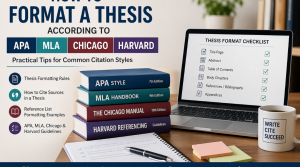
Writing a thesis requires careful planning, strong research skills, and a clear structure. Many students struggle with organizing their work effectively, which is why following a checklist for writing each chapter of a thesiscan be invaluable. From the introduction and literature review checklist to the thesis research design chapterand thesis findings chapter, every section serves a specific purpose. This thesis chapter by chapter guide provides a practical thesis chapter checklist to help students understand how to write each chapter of a thesis and produce a well-structured academic document.
Understanding the Importance of a Thesis Structure
Academic research follows a systematic structure designed to communicate complex ideas clearly and logically. Universities worldwide generally follow a similar framework consisting of an introduction, literature review, methodology, results, discussion, and conclusion. While specific requirements vary by institution and discipline, the overall purpose remains consistent: to guide readers through the research journey.
According to guidelines published by the Purdue Online Writing Lab (OWL) and the University of Southern California Research Guides, a successful thesis should establish a clear research problem, situate the study within existing scholarship, explain the methodology, present findings objectively, and discuss their implications critically.
Chapter 1: Introduction Checklist
The introduction serves as the foundation of the thesis. It provides readers with essential context and establishes the significance of the research problem.
When preparing the introduction, ensure that the following elements are included:
- A clear statement of the research problem.
- Background information explaining the context of the study.
- The rationale and significance of the research.
- Research aims and objectives.
- Research questions or hypotheses.
- Scope and limitations of the study.
- Definition of key terms and concepts.
- An overview of the thesis structure.
One common mistake is providing excessive background information without clearly identifying the research gap. According to research methodology experts, the introduction should move logically from a broad discussion of the topic to a specific statement of the problem being addressed.
A strong introduction answers the fundamental question: Why does this research matter?
Chapter 2: Literature Review Checklist
The literature review demonstrates the researcher’s understanding of existing scholarship and identifies gaps that justify the study.
A comprehensive literature review checklist should include:
- Identification of major theories related to the topic.
- Review of relevant empirical studies.
- Critical evaluation of previous research.
- Comparison of conflicting viewpoints.
- Identification of methodological strengths and weaknesses in existing studies.
- Discussion of research gaps.
- Development of a conceptual or theoretical framework.
- Clear connection between previous studies and the current research.
Students often mistakenly summarize studies rather than critically analyzing them. A literature review should not simply describe what previous researchers found; it should evaluate the quality, relevance, and limitations of existing knowledge.
The Cochrane Library and Google Scholar are valuable resources for locating peer-reviewed literature and identifying influential studies within a discipline.
Chapter 3: Methodology and Research Design Checklist
The methodology chapter explains how the research was conducted and why specific methods were chosen. This section is often referred to as the thesis research design chapter because it outlines the framework used to answer the research questions.
The methodology checklist should include:
- Research philosophy or paradigm.
- Research approach (qualitative, quantitative, or mixed methods).
- Research design.
- Population and sampling strategy.
- Data collection methods.
- Research instruments.
- Data analysis procedures.
- Reliability and validity considerations.
- Ethical considerations.
- Limitations of the methodology.
According to the American Psychological Association (APA) Research Resources, transparency in methodology is essential because it allows readers to evaluate the credibility and reproducibility of the research.
Researchers should justify every methodological decision rather than merely describing the methods used. For example, if interviews were selected instead of surveys, the rationale should be clearly explained.
Chapter 4: Results and Findings Checklist
The results section presents the data collected during the study. Depending on institutional requirements, this may be labeled as the thesis findings chapter or simply the results chapter.
A practical results chapter writing guide includes the following checklist:
- Presentation of findings in a logical order.
- Use of tables, charts, and figures where appropriate.
- Clear reporting of statistical analyses.
- Objective presentation of results without interpretation.
- Alignment between findings and research questions.
- Accurate labeling and numbering of tables and figures.
- Reporting of significant and non-significant findings.
- Consistency in terminology throughout the chapter.
One of the most common errors is mixing results with discussion. The purpose of this chapter is to report what was found, not why it was found.
For quantitative studies, researchers should provide sufficient detail regarding statistical tests and outcomes. For qualitative studies, findings should be supported by participant quotations or thematic evidence.
An effective thesis findings chapter communicates results clearly and objectively while maintaining a direct connection to the research objectives.
Chapter 5: Discussion Checklist
The discussion chapter interprets the findings and explains their significance within the broader academic context.
A comprehensive discussion checklist includes:
- Interpretation of key findings.
- Comparison with previous research.
- Explanation of unexpected results.
- Theoretical implications.
- Practical implications.
- Contribution to existing knowledge.
- Consideration of limitations.
- Recommendations for future research.
This chapter demonstrates the researcher’s analytical abilities. Rather than simply restating findings, the discussion should explain how the results answer the research questions and contribute to the field.
Current debates in academic research increasingly emphasize the importance of research impact. Scholars are expected not only to generate knowledge but also to demonstrate how their findings can influence policy, practice, or future scholarship.
The discussion chapter serves as the bridge between empirical evidence and meaningful academic contribution.
Chapter 6: Conclusion and Recommendations Checklist
The conclusion brings the thesis to a logical and persuasive close.
The final chapter should include:
- Summary of key findings.
- Direct answers to research questions.
- Summary of contributions to knowledge.
- Practical implications.
- Policy recommendations where relevant.
- Suggestions for future research.
- Final reflections on the significance of the study.
A strong conclusion avoids introducing new evidence or arguments. Instead, it synthesizes the major points presented throughout the thesis and reinforces the importance of the research.
The conclusion should leave readers with a clear understanding of what was achieved and why the study matters.
Final Thesis Quality Checklist
Before submission, researchers should conduct a comprehensive review of the entire document.
The final dissertation chapter checklist should verify:
- Consistency in formatting.
- Compliance with university guidelines.
- Accurate referencing and citations.
- Absence of plagiarism.
- Logical flow between chapters.
- Clear alignment between objectives, methods, findings, and conclusions.
- Correct grammar and spelling.
- Professional academic language.
- Complete appendices and supplementary materials.
Research from the Committee on Publication Ethics (COPE) highlights that accurate citation and ethical reporting are fundamental components of scholarly integrity. Even high-quality research can lose credibility if presentation and documentation standards are not maintained.
Why Professional Thesis Editing Matters
Even experienced researchers benefit from professional editing. After spending months or years on a project, it can become difficult to identify structural inconsistencies, grammatical errors, and weaknesses in argumentation.
Professional editors provide an objective review of the manuscript, ensuring clarity, coherence, and compliance with academic standards. Services such as Thesis Edit specialize in thesis proofreading, substantive editing, formatting, and academic language enhancement. For students facing tight deadlines or institutional requirements, expert editing can significantly improve the quality and presentation of the final document.
Conclusion
A well-organized thesis is built on strong planning and a clear understanding of each chapter’s purpose. By following this thesis chapter checklist and dissertation chapter checklist, students can confidently navigate every stage of the writing process. Whether preparing a literature review checklist, developing a thesis research design chapter, or using a results chapter writing guide, this checklist for writing each chapter of a thesis helps ensure academic quality, coherence, and successful thesis completion.